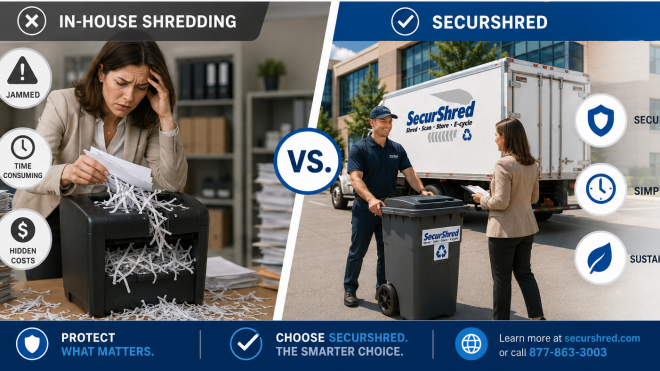
Which is right for your business?
Every business handles confidential information. Employee records, customer files, financial documents, contracts, and other sensitive materials all require secure disposal when they are no longer needed. Many organizations assume an office shredder is the simplest solution. While in-house shredding may work for small volumes, it often comes with hidden costs and security risks that businesses overlook.
So how does in-house shredding compare to professional shredding services?
The Pros and Cons of In-House Shredding
Office shredders can be convenient for occasional use. If you only need to destroy a few documents at a time, they may seem like a cost-effective solution. However, challenges quickly emerge as document volumes increase.
Time and Productivity
Most office shredders handle only a small number of pages at once. Employees must remove staples, clear paper jams, empty bins, and spend valuable time feeding documents through the machine. For businesses managing dozens of boxes of records, that time can add up quickly.
Equipment Costs
Office shredders require maintenance and eventual replacement. Frequent use can lead to overheating, worn cutting blades, and mechanical failures. When you factor in equipment costs and employee labor, in-house shredding is often more expensive than expected.
Security Risks
One of the biggest concerns with in-house shredding is inconsistency. Documents may sit in boxes for weeks waiting to be shredded. Employees may become distracted or accidentally dispose of records improperly. Without a documented process, businesses may have difficulty proving information was securely destroyed.
Why Professional Shredding Offers Greater Security
Professional shredding companies are designed to provide secure, documented destruction of confidential information.
Rather than relying on employees to shred documents manually, businesses can implement a secure process that protects records from collection through destruction.
Benefits often include:
- Secure collection containers
- Chain-of-custody procedures
- Scheduled pickups
- Certified destruction
- Certificates of Destruction
- Reduced employee involvement
This creates a more consistent and reliable approach to information security.
Compliance Matters
Many organizations must comply with regulations governing the disposal of sensitive information.
These include:
- Healthcare providers
- Financial institutions
- Municipalities
- Schools and universities
- Legal offices
- Human resource departments
Professional shredding services help organizations maintain documented destruction procedures that can support audits and compliance efforts.
Documents That Should Be Securely Destroyed
Many people think only financial documents require shredding. In reality, any document containing personal or confidential information should be securely destroyed.
Examples include:
- Tax records
- Payroll files
- Personnel records
- Medical information
- Customer files
- Insurance documents
- Legal paperwork
- Banking information
If the information could be used for identity theft or expose confidential business operations, secure destruction is recommended.
When an Office Shredder Makes Sense
There are situations where in-house shredding remains practical.
For example:
- A small home office
- Occasional document disposal
- Immediate destruction of a single sensitive document
However, once organizations begin generating larger volumes of confidential records, professional shredding often becomes the safer and more efficient option.
Free Community Shred Events
For individuals looking to dispose of personal records, SecurShred partners with local organizations throughout Vermont and New Hampshire to host free community shred events.
These events give residents a safe way to destroy:
- Old tax returns
- Bank statements
- Medical records
- Credit card offers
- Personal paperwork
Free shred events are held throughout the summer and continue into the fall, helping community members protect themselves from identity theft while responsibly recycling paper.
Events are hosted in communities across Vermont, northern New York, northern Massachusetts, Maine and New Hampshire, with new dates added throughout the year. Check SecurShred’s event calendar regularly for the latest schedule.